Friday, May 20, 2011

#77 Crazy Betsy

Elizabeth Van Lew, or "Crazy Betsy"


Elizabeth Van Lew hated slavery, which, for a woman living in Richmond when the Civil War broke out, was odd in and of itself. But she was also outspoken, and dressed strangely, which earned her the name of "Crazy Betsy," or "Crazy Bet." Nevertheless, her neighbors had no idea how strange she actually was: she was a Union spy.

Born, raised, and schooled in Philadelphia, Lizzie, as her family knew her, lived with her mother in Richmond following her father's death. When the war broke out, she was in her 40s, and was a staunch Unionist.

The most remarkable thing about Van Lew is that she was pro-Union out in the open. On days of fasting and prayer proclaimed by the Confederate government, Van Lew held elaborate meals and openly voiced her opinions against slavery.

In retrospect, it seems that her eccentricities helped advance her plight to help the Union and its soldiers. Everyone saw her as harmless, and therefore let her do as she wished. As the war progressed, she refitted her home with secret passages, hidden rooms, and supposed tunnels that led to the James River. Many escapees are believed to have taken shelter there on their way northward.

She also gained access to the prisons to carry books and food to the imprisoned Union officers, who passed her information that had been overheard. Moreover, Van Lew organized a Union sympathizer group in Richmond, which included Elizabeth Bowser, an African-American woman who was on the whitehouse staff and overheard important conversations as she served meals and attended to Jefferson Davis.

In retrospect, it is truly remarkable how she was able to hide in plain sight, being dismissed as slightly crazy person, yet be among the most effective spies for the entire Civil War. General U.S. Grant stated that Van Lew had provided the most valuable information from Richmond during the war. He later appointed her postmistress of the city.

Sources:

"Civil War Podcast by Dr. James Robertson," produced by WVTF Public Radio. Accessed at  http://www.wvtf.org/news_and_notes/feeds/wvtf_cw_rss.php on May 20, 2011.

"Elizabeth Van Lew." Accessed at http://www.civilwarhome.com/vanlewbio.htm on May 20, 2011.

Thursday, May 5, 2011

#76 Carrying the Log and Other Punishments


"Too Fond of Whiskey." Source: Library of Congress
 The Civil War, like all wars, consisted of long stretches with nothing to do broken up by short periods of marching and fighting. During the slow times, Union soldiers in Virginia passed the time by stealing food from nearby southern farmers, getting drunk, gambling, fighting among themselves, or all of the above. The creativity of the offenses were often met with equally creative punishments.

1) Carrying the Log: For minor offenses, soldiers had to substitute his rifle for a thick log, that he had to carry with him wherever he went. Often, he would be called to guard the tent of the officer responsible for making him carry it.

2) Fit to be Tied: For moderate offenses, a soldier might have to sit with a stick placed behind his knees with his hands tied together in front of his ankles, and a bayonet in his teeth.

3) Barrel Balance: Also for moderate offenses, this punishment consists of removing the lid from a barrel and forcing the soldier to stand, and balance, on the rim. Soldiers were also made to wear the barrel, and only the barrel.

4) Branding and Flogging: For major offenses, such as attempted disertion, soldiers might have been branded, flogged, or hung up by their thumbs.

5) Death: The worst offenders were shot, sometimes sitting on their own coffins, or hanged.

Sources:
Gone for a Soldier: The Civil War Memoirs of Private Alfred Bellard

Monday, May 2, 2011

#75 Toppling the Stonewall

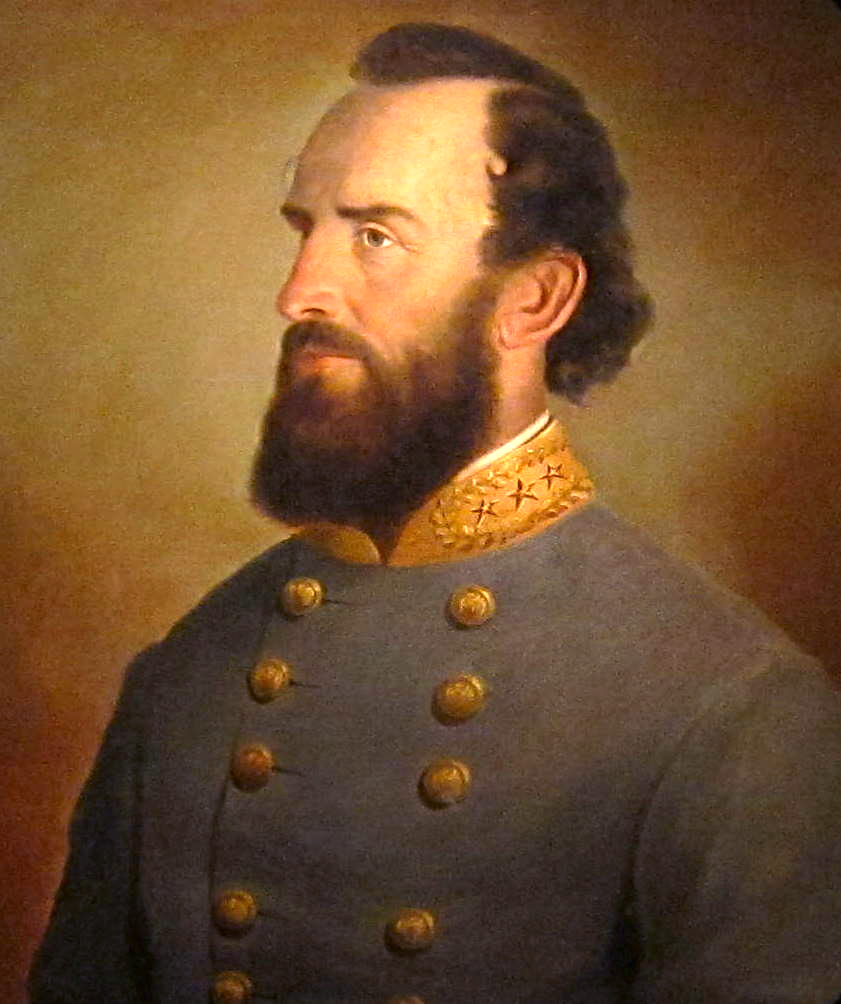
A portrait of Stonewall Jackson (1864, J. W. King)
located in the
National Portrait Gallery in Washington, D.C.

Before the death of the nefarious terrorist leader, Osama Bin Laden, May 2nd commemorated the mortal wounding of another rebel who fought against the United States: Johnathan "Stonewall" Jackson. While General Johnathan Jackson was certainly no terrorist, and is still considered many to be one of the greatest generals in amercian history, there is no doubt that his death played a pivotal part in the eventual victory of the Union over the Confederacy.

Jackson both distinguished himself and earned the nickname "Stonewall" at the First Battle of Bull Run. General Barnard Bee exclaimed that Jackson's brigade was standing like a stone wall, which, depending on the source, meant that it was either staying strong and not giving up any ground or was just standing there and not coming to help reinforce Bee. In any case, the name stuck, and the brigade, following Jacksons promotion to general, retained the name "Stonewall Brigade."

On May 2nd, 1863, following a successful campaign that routed the Union forces at Chancellorsville, Jackson was returning to his own lines when he was shot by his own men. A week later, on May 10th, he died of pneumonia that was considered a complication caused by the wound.

Source: http://www.civilwarhome.com/jackbio.htm

Wednesday, April 27, 2011

#74 Titanic of the Mississippi

At 2:00 a.m. on April 27, 1865, three boilers suddenly exploded on the paddleboat Sultana, which was carrying 2,400 passengers consising mostly of newly freed Union prisoners who had managed to survive the horrors of Andersonville. Approximately 1,800 people died in the accident, which is considered the worst maritime disaster in U.S. history.

It was believed that the cause was low water in the boilers combined with the fact that the ship was top heavy, causing hot spots to form as the boiler water swished back and forth causing steam pressure to build. However, in 1888, a man named William Streetor claimed that his business partner, Robert Louden, confessed on his deathbed that he had sabotaged the Sultana using a coal torpedo. Nevertheless, what actually occurred remains a mystery.


The Sultana

Thursday, October 7, 2010

#73 Making Due

As commodities became scarce in the South, men and women made due with what they had. Soap, for example, was produced from home out of water, lye, and grease. To produce lye, water was filtered through a tray of wood ash. When meat was scarce, china berry and cottonseed oil was used as a grease-substitute.

Toothbrushes and tooth powder were highly valued and in short supply. Such things as arrowroot, chalk, charcoal, cuttlefish bone, honey, myrrh, orris root, and salt and soda were used as tooth powder. Hog bristles, twigs, or the licorice roots were used as toothbrushes.

Rice flour was a substitute for face powder and melted lard mixed with rose petals was used as hair oil.

When paper was scarce, individuals made the most of what they had. They would write a full page and then turn the paper 90 degrees and fill the paper that way. It made the letter difficult to read but not impossible. Ink was made using dogwood extract or elderberries.

cross_writing024

(Source: Varhola, Michael J. Everyday Life During the Civil War: A Guide for Writers, Students, and Historians. Cincinnati: Writer's Digest Books. 1999.)

Tuesday, October 5, 2010

#72 The Ballad of Widow Fritchie

Barbara Fritchie, age 96,  of Frederick, Maryland, was immortalized in a poem for something she had nothing to do with. In September 1862 Lee's army was heading northward through the town. As they marched, so the story goes, they dragged a captured American flag through the dirt. Upon seeing this, Mrs. Fritchie, otherwise bedridden, hobbled out of her house and began to curse at the soldiers and their leader, Stonewall Jackson. According to the ballad by John Greenleaf Whittier this is what happened:

"Shoot, if you must, this old gray head
But spare your country's flag," she said."

A shade of sadness, a blush of shame,
Over the face of the leader came;

The nobler nature within him stirred
To life at that woman's deed and word;

"Who touches a hair of yon gray head
Dies like a dog! March on!" he said.

All day long through Frederick street
Sounded the tread of marching feet;

All day long that free flag tost
Over the heads of the rebel host.

The real Barbara Hauer Fritchie stayed in her bed during the entire Confederate occupation. Jackson had entered the city in an ambulance as the result of being thrown from a horse. When he left the city, Jackson had taken a different route than his troops, who passed the Fritchie home.

After the Confederates left and the Union soldiers entered the city, the sweet old woman got out of her bed and appeared in her doorway waving an American flag that had been stored between the pages of her family bible. Her niece thought the woman's patriotism would make a good article for the newspaper and passed it along. The story, however, evidently became mixed with a third-hand account mentioned by a doctor in Fredericksburg who heard from a clergyman that an unidentified old woman berated the Confederate troops for their mistreatment of the flag.

Like wildfire, the story-turned-legend raged through the Union ranks, adding details as it went until it reached the ears of the Whittier. For decades afterward, its origins and validity were studied and questioned.

Fritchie died in December, 1862, and never knew of the immortal fame she had earned.

(Source: Davis, Burke. The Civil War: Strange & Facinating Facts. New York: Wings Books. 1960.)

Monday, October 4, 2010

#71 "That Is What He Said..."

On May 14, 1942, the Cincinnati Orchestra played music that had never been heard before, but would become one of the most popular orchestral works of all time. Under the direction of the composer, Aaron Copland, the orchestra played "Lincoln Portrait" which included excerpts from speeches--including the Gettysburg Address--that were spoken by William Adams.

Copland was commissioned by Andre Kostelanetz to write the piece as part of a three-part presentation lauding some of the nation's most important individuals. Jerome Kern wrote a piece about Mark Twain and Virgil Thompson highlighted New York Mayor Fiorello La Guardia and journalist Dorothy Thompson. At first, Copland wanted to compose a piece about Walt Whitman, but Kostelanetz asked him to choose a statesman instead. That's when Copland chose Lincoln. I, for one, am glad he did.


Here's the text of the narrative to accompany the orchestration:

Fellow citizens, we cannot escape history."

That is what he said. That is what Abraham Lincoln said.

"Fellow citizens, we cannot escape history. We of this congress and this administration will be remembered in spite of ourselves. No personal significance or insignificance can spare one or another of us. The fiery trial through which we pass will light us down in honor or dishonor to the latest generation. We, even we here, hold the power and bear the responsibility." [Annual Message to Congress, December 1, 1862]

He was born in Kentucky, raised in Indiana, and lived in Illinois. And this is what he said. This is what Abe Lincoln said.

"The dogmas of the quiet past are inadequate to the stormy present. The occasion is piled high with difficulty and we must rise with the occasion. As our case is new, so we must think anew and act anew. We must disenthrall ourselves and then we will save our country." [Annual Message to Congress, December 1, 1862]

When standing erect he was six feet four inches tall, and this is what he said.

He said: "It is the eternal struggle between two principles, right and wrong, throughout the world. It is the same spirit that says 'you toil and work and earn bread, and I'll eat it.' No matter in what shape it comes, whether from the mouth of a king who seeks to bestride the people of his own nation, and live by the fruit of their labor, or from one race of men as an apology for enslaving another race, it is the same tyrannical principle." [Lincoln-Douglas debates, 15 October 1858]

Lincoln was a quiet man. Abe Lincoln was a quiet and a melancholy man. But when he spoke of democracy, this is what he said.

He said: "As I would not be a slave, so I would not be a master. This expresses my idea of democracy. Whatever differs from this, to the extent of the difference, is no democracy."

Abraham Lincoln, sixteenth president of these United States, is everlasting in the memory of his countrymen. For on the battleground at Gettysburg, this is what he said:

He said: "That from these honored dead we take increased devotion to that cause for which they gave the last full measure of devotion. That we here highly resolve that these dead shall not have died in vain. That this nation under God shall have a new birth of freedom and that government of the people, by the people, and for the people shall not perish from the earth."

(Sources: Pollack, Howard, Aaron Copland: The Life and Work of An Uncommon Man. New York: Henry Holt & Company. 1999. Child, Fred. "Copland's 'Lincoln Portrait.'" Transcription of National Public Radio broadcast. Aired November 10, 2004.)